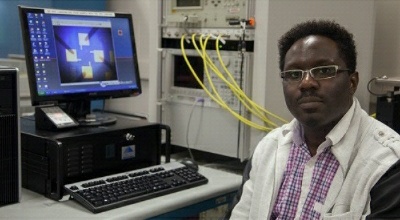
Obama gives US highest research award to Akinwande, Nigerian professor


Deji Akinwande, a Nigerian professor in the US, has received America’s highest research award.

Earlier in the year, Akinwande was named by President Barack Obama, as one of the recipients of “the highest honour bestowed by the US government for science and engineering professionals in the early stages of their independent research careers”.

Speaking to TheCable on Monday, Akinwande said he was awarded by Obama on May 5, 2016, at the White House, where the 105 researchers were hosted.

Obama and the Researchers (Akinwande marked in Green)


According to the White house, Akinwande was awarded for his “outstanding research accomplishments in nanomaterials, graphene device physics, and opto-electronics, and for dedication to the education of future scientists and engineers”.

Annoucing the winners earlier in the year, Obama said: “These early-career scientists are leading the way in our efforts to confront and understand challenges from climate change to our health and wellness.

“We congratulate these accomplished individuals and encourage them to continue to serve as an example of the incredible promise and ingenuity of the American people.”

In an interview with TheCable, Akinwande, who grew up in Opebi Allen in the Ikeja area of Lagos state, said he left Nigeria as a teenager in 1994, and his novel idea is aimed at building more energy efficient electronic chips to make mobile phones last a week or two without charging.

The Cable.

Comments

Popular posts from this blog

Understanding Prof. Yemi Osinbajo - Abraham Ogbodo

Abraham Ogbodo I am trying to understand Prof. Yemi Osinbajo, the Vice President of the Federal Republic of Nigeria. Often, he speaks out of character. That is, he talks as if he is Vice President before he is a professor of law, even when I know that the latter comes first. The man wasn’t like this when he was the attorney general of Lagos State and a teacher at the Law Faculty of the University of Lagos. Then, his statements were measured and as a seasoned lawyer, based on facts. But today, Osinbajo is sounding like Adams Oshiomhole, a union leader, who by the grace of God, became governor of Edo State for eight years. The revelations about big thefts in the economy had come more from Adams than even Ibrahim Magu, chairman of the EFCC. It was Adams who said former petroleum minister; Mrs. Diezani Allison-Madueke alone stole 13 billion British pounds from the national treasury. That is like saying she stole in raw cash almost twice as much as the entire fortune of Alhaj...

FG borrows N3.38bn To Aid Potato Production in Plateau

The Federal Executive Council (FEC) wednesday approved N3.38 billion to boost the production of potatoes in Plateau State. The Minister of Finance, Mrs. Kemi Adeosun, who made the disclosure said the money would be borrowed from Agricultural Development Bank (ADB) with one per cent interest rate and 25 years moratorium. The minister who said the loan was not fresh, explained that it had previously been cancelled by the federal government with the intention to make a fresh request for the loan on behalf of Plateau State which she said was responsible for 95 per cent of potato production in the country. According to her, following ADB’s comprehensive programme on potato production in Plateau State, 100,000 families and 17 local government areas of Plateau State would benefit from the loan while 60,000 jobs would be created by the initiative. “My approval was on behalf of Plateau State to support the potato value chain. There is a loan that we had previously cancelled from ...

Much ado about the foreign reserves - Nonso Obikili

I have received a lot of questions about the Central Bank of Nigeria’s (CBN) foreign reserves recently. The CBN has of course been touting the reserves growing from a low of about $24bn to the approximately $42bn it is now. The questions typically centre around why we are keeping so much in reserve when the economy is struggling, and we have poor infrastructure? Why don’t we use the reserves to reduce the poverty that is rampant? The question typically betrays a little bit of misunderstanding over what the foreign reserves are and how the entire thing works. Hopefully, after reading this we will have a better understanding of what it is and what it can and can’t be used for. First, what is the “Foreign Reserves?” It is the amount of foreign exchange that the central bank has at its disposal at any point in time. Some of this is in cash and some in other liquid assets, that is assets that can quickly be turned to cash. Some of this is in US dollars but sometimes it’s in other c...